- The Water Folk
Merfolk, these aquatic beings have the head and upper body of a human and the lower body of a fish. Mermaid like the siren, lures men to their doom. In Shetland lore, mermen are of a darker complexion than the women, with hair and beards of various colours; for instance, brown, black, grey, and reddish. Mermaids have fine features, light skin, and very long yellow hair.
I often tell my grandfather’s tale of the merfolk of Turnberry. They would bask in the sun on rocks stretching out from Turnberry lighthouse, and that there were a number of stories of young men having drowned in the sea, their minds captured by the merfolk’s mesmerising song.
Selkie, the seal-folk. Marriages between seal-woman and young fishermen were quite common. In 1895 a Shetland woman named Baubi Urquhart claimed to be the great-great-granddaughter of a seal, and that she knew of many other people in nearby villages that could claim such ancestry.
Some islanders believed that the Selkie folk were fallen angels, just like Fairies; condemned to a state of neither animal nor human form. Others believed that they were indeed human but were condemned to exist in the form of a seal.
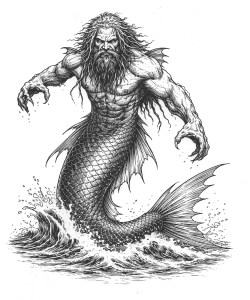
Fin Folk are a curious race that live on both land and water and are difficult to categorise. Some writers suggest they are a race of Fairies, but native Orkney and Shetland folklorists writing in the 19th century suggest they are similar to Selkies.
They were real people who had the power of assuming seal-form. These Fins could make themselves visible or invisible to humans or transform themselves into seals when they wanted to go fishing or to travel rapidly from island to island.
Blue Men. Prior to their inclusion amongst the fallen angels, the Blue Men were associated with the seal-folk. The Blue Men sleep in subaqueous caves until summoned to a passing boat, whereupon they will grab the keel in an attempt to topple both boat and crew into the sea.
2. Demons of Land and Water
Nuckelavee is the nastiest of all the demons inhabiting the Northern Isles. Its breath was like a venom, said to wilt crops and sicken livestock, and this demon was held responsible for all droughts and sicknesses of both human and animal on land. According to folklorist and antiquarian, Water Trail Dennison, an Orcadian resident, Nuckelavee means “Devil of the Sea”.
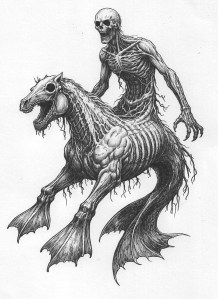
Seonaidh (or Shony) was a sea demon from the Isle of Lewis. Described as a large human with thick shaggy hair and a ridge of fins running down its back. Human sacrifice was made once a year to it, either a fisherman with his throat slit and thrown overboard.
Tangie is a demonic sea spirit is found in the Orkney and Shetland Isles. It has the attributes of both sea horse and merman, although preferring the form of either a horse or an elderly man. Black Eric was a legendary sheep thief in Shetland who lived in a cave at Fitful Head, and just beneath the clifftop is the cave known as Thief’s House. The Tangie he rode gave him supernatural assistance when he raided and harassed surrounding crofts.
3. Fuath
Fuath is the generic term for all malevolent water spirits that live in rivers and lochs, also going by the names River Hag and Water Wraith; generally female, wearing green and having a withered face. They are Nursery Bogeys, that is, beings used to frighten children with: “Don’t get too close to the water’s edge or the Wraith might get you”.
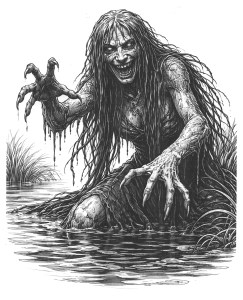
I know this being by her Cumbrian name of Jenny Greenteeth. She haunts lakes and rivers in numerous localities in the northwest of England, creeping to the water’s edge to catch those standing too close, then pulling them down into her watery lair to devour. Her other names are Grindylow and Peg Powler. You can read more in my Folklore of the Lake District.
4. The Water Horses
Each-uisge is a water-horse in Gaelic and is known for immediately heading for deep water to drown and eat its rider, just not their liver, it hates human liver.
Morag married a handsome man not realising than he was an Each-uisge. One day she discovered sand in his hair and realised his true nature, so she fled with their son. In two ballads, the Each-uisge sings to the child, hoping Morag will return. The songs are of Norse origin and taken from the folk-ballad Agnes and the Merman.
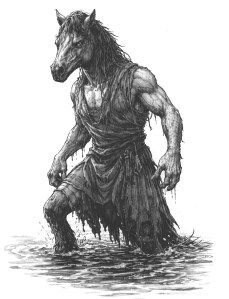
In traditional Gaelic lore, the Kelpie wasn’t a malevolent being, it neither drowned nor ate humans. When out the water and in the form of handsome man Kelpie retains its horse hooves, leading to association with the devil, as found it Robert Burns’ 1786 Address to the Deil:
When thowes dissolve the snawy hoord, An’ float the jinglin’ icy boord, Then water-kelpies haunt the foord, By your direction, And ‘nighted trav’llers are allur’d, To their destruction.
Nuggle is of primarily Shetland folklore, with a few mentions in Orcadian lore. In Shetland it’s also called Shoopiltee. This water-horse is nocturnal and always male, inhabiting the rivers, streams and lochs. It is easily recognised by the distinctive wheel-like tail hidden between its hind legs that acts like a propeller.
5. Loch and Sea Monsters
Swedish naturalist and author Bengt Sjogern proposed that present beliefs in water monsters are associated with Kelpie legends. Descriptions of these ‘monsters’ have changed over time, especially now that dinosaurs are an intrinsic part of our culture, but they were originally associated with this horse-like creature.
Whilst the most famous Loch Monster is Nessie, his cousin is Morag of Loch. Recorded sightings of Morag began in the 1800s; a beast the size of a full-grown Indian elephant sitting on rocks before “plunging into the loch with a terrific splash”.
The Life of St Columba written around the year 700CE not only describes St. Columba’s encounter with ‘Nessie’, but also a huge swarm of “deadly loathsome little creatures” in the ocean, north of Orkney. They were about the size of frogs and exceedingly troublesome because they had spines.
When my father and his brother were young, a thirty feet long sea monster washed ashore at nearby Girvan, Ayrshire. It had the long neck of a giraffe, a head not unlike that of a camel, and twelve feet long tail. Whilst locals lamented the loss of one of their beloved sea creatures, the ‘experts’ concluded it was the partially decomposed carcass of a basking shark.
6. Dragon and Wurm
Islay, Sutherland and Ayrshire have dragon tales, but perhaps the most famous are the Bheithir Dragons of Argyll and the central Highlands. They venture out of their lair only on summer nights when lightning strikes occur and are able to devour seven horses in a single night.
A common tale in folklore is off a dragon meeting its end having devoured a human wearing or an object containing iron spikes. One such tale takes place in my native Ayrshire, of a canny blacksmith making a suit of armour adorned with spikes.
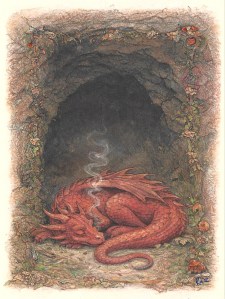
Nine Maiden’s Well. A farmer blessed with nine daughters, one day sent one of them to the well to fetch him a draught of water, not returning, he sent. None of them returning, daughter after daughter was sent, till the whole nine had been despatched on the same errand. Eaten by dragon or wurm. Wurm being a dragon with no wings nor legs, a large serpent.
7. Giants and Hairy Folk
“At this time the island of Britain was called Albion. It was uninhabited except for a few giants… and then the humans arrived”~ Geoffrey of Monmouth, 1136
A giantess lived in Ross and Cromarty. The opposing headlands at Munlochy Bay were occupied by rival Fomorians who regularly threw their battle-axe at one another. One such giant was so severely wounded by his rival’s axe that he was unable to continue, whereupon his wife took up the challenge. Her aim was so true that again and again the axe struck the forehead of the rival.
One of the oldest recorded folk tales in Scotland, published in 1550 is that of ‘The Red Etin’ a three-headed Ogre who lived at Edin’s Hall Broch in Berwickshire. He had a herd of two-headed, eight-horned oxen. Any traveller who encountered Etin was immediately asked three riddles, and if unable to answer, was turned into a pillar of stone.
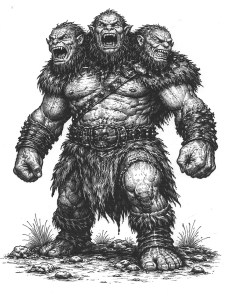
The big grey man of Ben Macdhui is a 10 feet tall giant humanoid covered in short hair. He utters a strange dialect similar to Gaelic and there is a feeling of dread in all who see him. One of the first documented encounters was with the poet James Hogg in 1791. Similar beings have been documented in Ayrshire, Galloway and Fife
8. Wolf Man and Werewolf
Little Red dare not fear, for the last wolf in Scotland was killed at Killiecrankie in 1680. She only has to worry about the werewolves now! In Hebridean legend, a family of werewolves lived on an island on Loch Langavat. Although they are reportedly long-dead, a superstition remains that should their graves by disturbed it will release their spirits.
Wulver is a friendly creature, possessing the body of a man covered in short brown fur, with the head of a wolf. He was never human and is unaffected by a full moon. He shuns human contact but may be spied sitting by the water’s edge, fishing.
9. Vampires
Canon William de Newburgh discusses ‘vampires’ in his Historia rerum Anglicarum, a history of England from 1066 to 1198. These vampires are more correctly referred to as ‘revenants’, and he documents two such tales from Berwick upon Tweed when still within Scotland, and from Melrose.
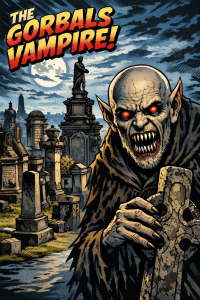
However, our most famous vampire tale is that of the Gorbals Vampire. On the evening of 23rd September 1954, the police were called to Glasgow’s Necropolis cemetery. Hundreds of children aged between four and fourteen, many armed with knives and sharpened sticks were hunting the graveyard for a seven foot “vampire” with iron teeth who had kidnapped and eaten two local children.
10. Spectral Cats and Demon Dogs
Black Dog, Shuck, Barguest; all are names for this shapeshifting black hound, common in folklore. Often invisible but for the sound of rattling chains, or able to shapeshift into inanimate objects. There are tales of ‘Black Dogs’ the length and breadth of Scotland, generally malevolent in nature, but for one tale from my native Ayr in which a Shuck rescued an infant that had been snatched from its cradle by a wolf.
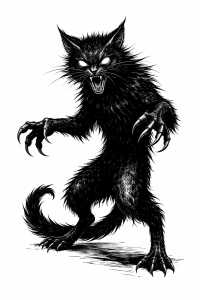
Big Ears was a demonic cat invoked during the ‘Taghairm’ ceremony, when live cats were sacrificed over fire. Big Ears would grant one wish to those who partook in the ceremony. Perhaps Big Ears is associated with Ieles, the vampiric cat able to walk on its hind legs.
11. Wyrd Creatures
There are numerous strange creatures in Scottish lore, but many have scant information associated with them. Here are two of my favourites.
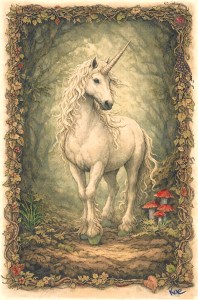
A unicorn on the Isle of Skye? The ‘beast of the lowering horn’ is a unicorn associated with the Isle of Skye and the Outer Hebrides, Generally aquatic, it was clumsy in appearance, having exceptionally long legs and a single towering horn that’s too big for its head.
My late grandfather would warn us grandkids to beware swimming in open water during the summer months. The Boobrie is a gigantic, green-coloured waterbird that although likes eating sheep and cattle, will consume a child if the opportunity presents itself.
 Folklore of Scotland