- Elf and Fairie
What is the difference between Elf and Fairie. Well perhaps there isn’t one. The word faerie was originally a reference to the weird and uncanny and fairy is of French origin. Elf means white being in the Germanic languages, but the earliest surviving texts are of Anglo-Saxon origin. Perhaps there was once only the Elfin folk, but Fairie became a more popular alternative name with the introduction of Fairy Tales.
As such, there are few folk tales that reference the Elf; a couple of tales from Ayrshire and from the Highlands.
In the Highlands, Fairies were an ‘alien’ race and the Elf were counterparts of the human race; or both were once fallen angels.
Fairie are “beings of small stature, but finely proportioned; of fair complexion, with long yellow hair hanging over their shoulders and gathered above their heads with combs of gold”.
They have become such as important part of our culture that there are numerous names they go by. The Ancient Ones, Bean Shith, Bendith Y Mamau, Blessed Folk, Blessed Ones, Children of Pride, Daoine Math, Daoine Shi, Daoine Sidhe, Elfins, Elfs, Fada, Fae Eire, Faerie, Faery Folk, Faery, Fae, Fai, Faierie, Faiery, Faine, Fair Family, Fair Folk, Fair, Fairies, Fairye, Fairy Family, Fairy People, Fane, Farie, Farisees, Fary, Fas, Fata, Fay, Faye, Fayerie, Fayery, Fayry, Fee, Feen, Feinen, Feiri, Fenoderee, Fenodrerr, Ferier, Ferisher, Ferrie, Ferrishyn, Fery, Fey, Feyrie, Feyrye, Folk, Forgotten People, Frairies, Fridean, Gentry,… Yarthkins.
There are numerous named Fairies in Scottish folklore, but many have only scant stories associated with them. There is the trickster Buachaillean, the ‘little herd boy’; the shapeshifter Lazy Lawrence who induces laziness and lethargy in mortals; Ly Erg who wanders Glenmore looking for a fight; Gan Ceannach the ‘love talker’, a solitary male Fairie who wanders the more remote places, known for his powers of seduction and is particularly fond of shepherds and milkmaids.
The book contains folklore as told to me by my grandparents, and my favourite tales from around Scotland.
2. Dwarf and Gnome
Dwarfs are typically portrayed as short, stout beings. They are associated with mining, blacksmithing, and creating magical items. Gnomes are also exceptional craftspeople spending most of their lives underground. They are small and generally bearded.
The Broon Man of the Muirs and the Mountains is a solitary dwarf. His race was once common throughout Scotland and northern England but is now only found in the most remote parts of the country. He is guardian to all wild animals and often seen with his companion, a red fox. His long, auburn curly hair and clothes made of moss and ferns make him almost invisible to the human eye.
Also known as the ‘Dwarf of Glen Etive’, Fachan is certainly an odd looking fellow. He hops around on a single leg that grows out from its body. He has one arm, not growing from the side from its shoulders, but a single arm growing out from its chest. On his head grows a single tuft of hair not unlike that of a horn, and he sports one eye in the middle of his face.
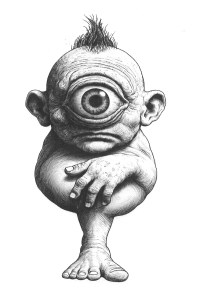
Pech are small but extremely strong gnome-like characters; known for brewing heather ale and battling the Scots. Many of Scotland’s stone circles were built by the Pech. They brewed the finest ale, made from heather, but the recipe was a secret, handed down from father to son. Even threatened by death, they wouldn’t divulge it.
In the Chapter Folk Poetry is the verse by Robert Louis Stevenson entitled Heather Ale: A Galloway Legend, that is either a reference to the Pech or the Picts.
3. Brownie Kin
The Brownie generally appears in folk tales from Scotland, but Brownies do appear elsewhere, and beings with brownie-like qualities appear in tales from around the world. One of the oldest accounts of a brobne comes from John Major the 15th Century Scottish philosopher, theologian and historian. Major states that “they thrash as much grain in one night as twenty men could do”.
Brownies live with humans, work at night in both house and farmyard, and their only payment is a bowl of cream, porridge or drop scones (pancakes) left at the fireside. Never offer a Brownie a set of clothes, it will leave. An example of this is the Brownie of Bodesbeck Farm, Moffat. He helped with the harvest each year, until on one occasion was rewarded with the gift of clothing, so he left.
“Gie Brownie coat, gie Brownie sark, ye ‘se get nae mair o’ Brownie’s wark!”
Shellycoat is a brownie-like being who lives outdoors and shuns human contact. He is easily recognisable by the coat of shells that he wears, as he sits by the water’s edge, fishing. Shellycoat may be spied along the banks of the River Ettrick, but upon seeing humans will jump into the water to flee.
4. Goblin Kin
Goblin is often described as up to two feet in height and covered in thick hair of a black, brown or dark grey colour, and is often nude. He can be both prankster and killer. There are nights of the year in which he is most active; in Scotland for example, it’s the three nights around Samhain.
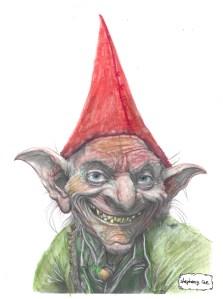
Perhaps the most famous goblin in Borders folklore is the Redcap. He is “a short, thickset elf with long prominent teeth, skinny fingers armed with talons like eagles, large eyes of a fiery red colour, grisly hair streaming down his shoulders, iron boots, a pikestaff in his left hand, and a red cap on his head”. In a traditional verse:
“Now Redcap he was there. And he was there indeed ; And grimly he girned and glowed, Wi’ his red cowl on his head.”
5. Hobgoblin Kin
Hobgoblin was originally classed as a more good-natured species of goblin, living with humans and having brownie-like characteristics, but through the years has been depicted as having the same malevolent traits as its goblin kin.
The Bugbear is often referred to as a hobgoblin. He is depicted as a hairy goblin, resembling a bear in appearance. Wee Willie Winkie is a Bugbear. Poet William Miller (1810-1872) added several verses to an existing nursery rhyme, and Wee Willie Winkie was first published in Whistle-binkie: Stories for the Fireside. In verse one of the original version:
Wee Willie Winkie rins through the toon,
Up stairs an’ doon stairs in his nicht-gown,
Tirlin’ at the window, crying at the lock,
“Are the weans in their bed, for it’s now ten o’clock?
6. Glaistig and Urisk
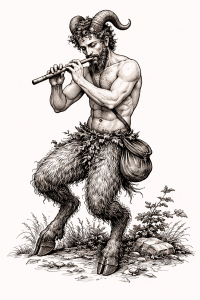
Both are half human and half goat nature spirits; and whilst the Glaistig is only depicted as female, the Urisk is both male and female. They both resemble a Faun or Satyr.
Folk tales vary concerning the Glaistig. She is half woman and half goat (lower half) being, living outdoors protecting both wild and domesticated animals. Her long golden hair falls into a green dress that hides these goat legs. She has malevolent, and benevolent characteristics.
Elsewhere in Scotland and due to religious superstition, she became the ‘The Green Lady’, a malevolent spirit associated with castles and other fortified homes, found wandering through woodland, at the side of a river, or near waterfalls, luring travellers to their doom.
Another being with a goat connection is the Urisk. The Urisk is half human and half goat (lower half), with long, often green, hair and sharp claws. In folklore traditions, Urisk is either the progeny from the union of Elf and human, the result of the Fairie’s curse, or one of the Faun.
At one time, many clan chiefs had an Urisk husband and wife as household helpers, and it became quite the fashion to encourage an Urisk to attach itself to one of the ‘great houses’ of Scotland.
7. Sprite and Spunkie
Both are, in general, spirits of the air, with or without wings and display both benevolent and malevolent characteristics.
Sprite is a small spirit of the air or fairie-being, generally harmless, sometimes a trickster, but also a type of ‘guardian angel’. In the South of Scotland every person is attended by a Sprite named Thrumpin at birth, but who rather oddly, also has the power of taking away that life.
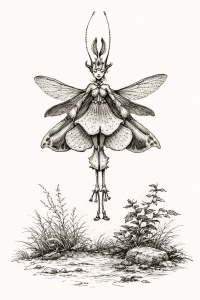
Tales of Cowlug Sprites occur in the Border villages of Bowden and Gateside. In local legend there was a strange belief that on a certain night of the year, called ‘Cowlug e’en’ a number of these Sprite would appear, sporting ears resembling those of cows.
Spunkie is a Will o’ the Wisp common is both Highland and Lowland folk tales. A malevolent nature spirit or fairie-being with the sole purpose of causing death to travellers on both land and sea.
“An’ aft your moss-traversin Spunkies. Decoy the wight that late an’ drunk is: The bleezin, curst, mischievous monkies. Delude his eyes, Till in some miry slough he sunk is, Ne’er mair to rise.”
 Folklore of Scotland