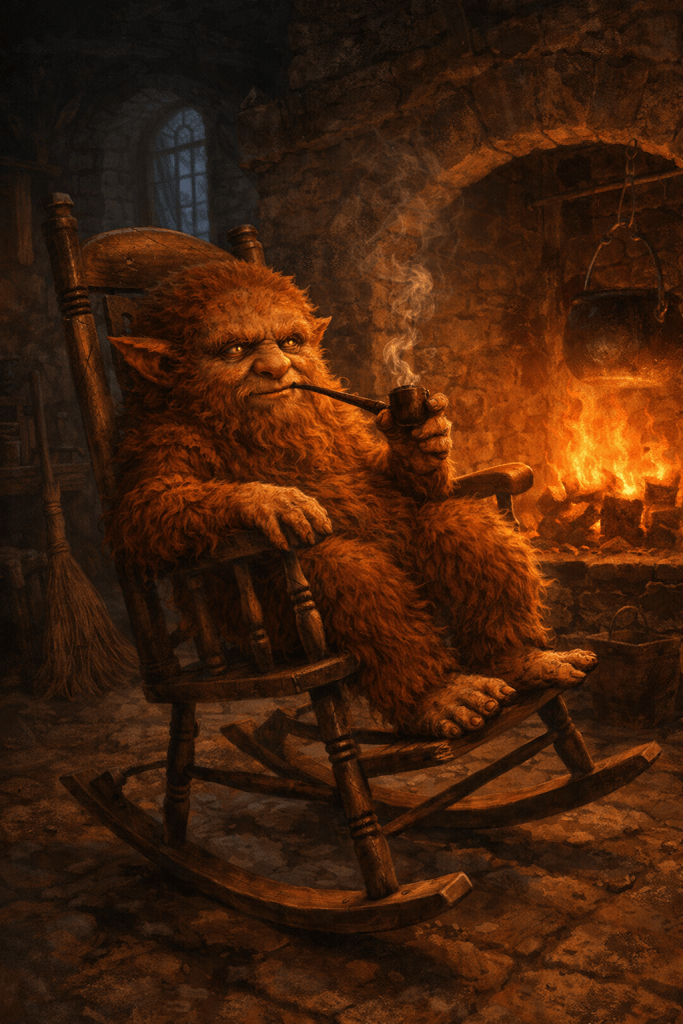
The Brownie generally appears in folk tales from Scotland, but Brownies do appear elsewhere, and beings with brownie-like qualities appear in tales from around the world. One of the oldest accounts of a brobne comes from John Major the 15th Century Scottish philosopher, theologian and historian. Major states that “they thrash as much grain in one night as twenty men could do”.
Brownies live with humans, work at night in both house and farmyard, and their only payment is a bowl of cream, porridge or drop scones (pancakes) left at the fireside. Never offer a Brownie a set of clothes, it will leave. An example of this is the Brownie of Bodesbeck Farm, Moffat. He helped with the harvest each year, until on one occasion was rewarded with the gift of clothing, so he left.
“Gie Brownie coat, gie Brownie sark, ye ‘se get nae mair o’ Brownie’s wark!”
Shellycoat is a brownie-like being who lives outdoors and shuns human contact. He is easily recognisable by the coat of shells that he wears, as he sits by the water’s edge, fishing. Shellycoat may be spied along the banks of the River Ettrick, but upon seeing humans will jump into the water to flee.
Goblin is often described as up to two feet in height and covered in thick hair of a black, brown or dark grey colour, and is often nude. He can be both prankster and killer. There are nights of the year in which he is most active; in Scotland for example, it’s the three nights around Samhain.
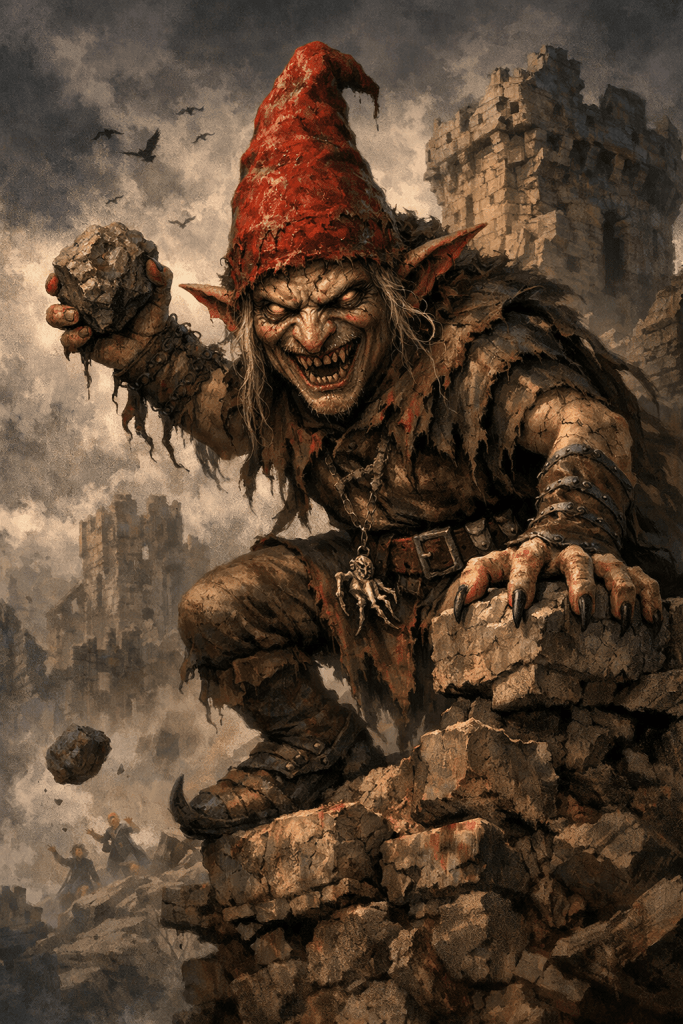
Perhaps the most famous goblin in Borders folklore is the Redcap. He is “a short, thickset elf with long prominent teeth, skinny fingers armed with talons like eagles, large eyes of a fiery red colour, grisly hair streaming down his shoulders, iron boots, a pikestaff in his left hand, and a red cap on his head”. In a traditional verse:
“Now Redcap he was there. And he was there indeed ; And grimly he girned and glowed, Wi’ his red cowl on his head.”
Hobgoblin was originally classed as a more good-natured species of goblin, living with humans and having brownie-like characteristics, but through the years has been depicted as having the same malevolent traits as its goblin kin.
The Bugbear is often referred to as a hobgoblin. He is depicted as a hairy goblin, resembling a bear in appearance. Wee Willie Winkie is a Bugbear. Poet William Miller (1810-1872) added several verses to an existing nursery rhyme, and Wee Willie Winkie was first published in Whistle-binkie: Stories for the Fireside. In verse one of the original version:
Wee Willie Winkie rins through the toon,
Up stairs an’ doon stairs in his nicht-gown,
Tirlin’ at the window, crying at the lock,
“Are the weans in their bed, for it’s now ten o’clock?
 Folklore of Scotland